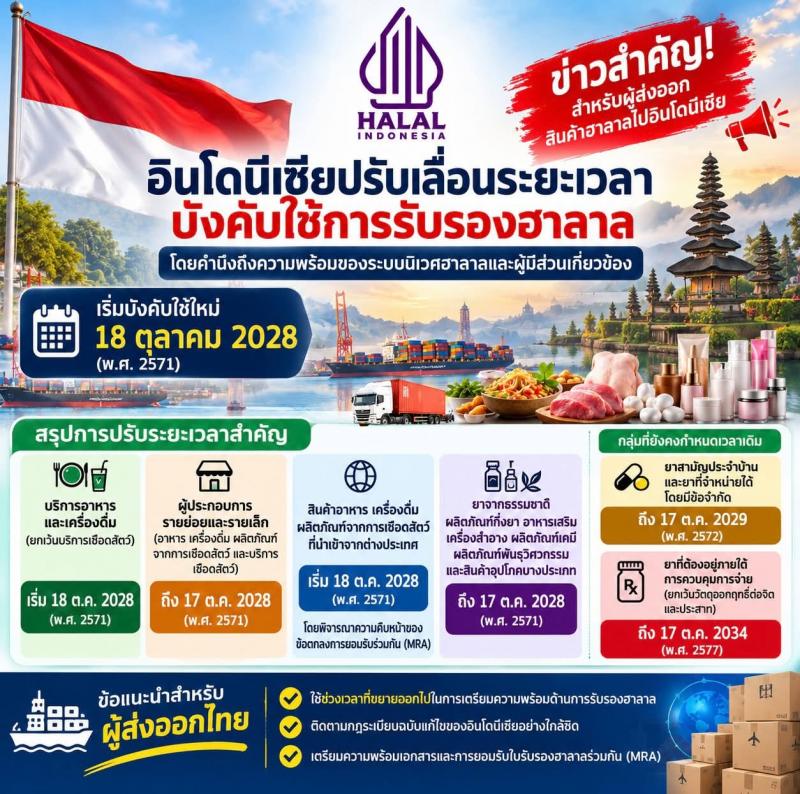
The Indonesian government has adjusted the implementation timeline for halal certification requirements.
99,999
2026-10-21
The Government of Indonesia Adjusts the Implementation Timeline for Mandatory Halal Certification, Taking into Account the Readiness of the Halal Ecosystem and Stakeholders
October 16, 2026, 20:44 hrs.
Coordinating Ministry for Economic Affairs of the Republic of Indonesia
Official Press Release
No. HM.02.04/361/SET.M.EKON.3/10/2026
Jakarta, October 16, 2026
The Coordinating Ministry for Economic Affairs of the Republic of Indonesia has provided clarification and disseminated information regarding the policy on mandatory halal certification requirements to relevant government ministries and agencies, the Halal Product Assurance Organizing Agency (BPJPH), business and industry associations, and all other stakeholders.
This initiative is part of the government’s efforts to ensure the effective implementation of halal certification requirements, while simultaneously considering the level of readiness of the national halal ecosystem.
The government acknowledges that the scope of the mandatory halal certification requirements is extensive, affecting millions of business operators across a wide range of industrial sectors.
These requirements are legally grounded in Law No. 33 of 2014 concerning Halal Product Assurance, as amended by Law No. 6 of 2023, with the corresponding operational provisions stipulated in... Government Regulation No. 42 of 2024 concerning the Implementation of Halal Product Assurance
Under Government Regulation No. 42 of 2024, the requirement for Halal certification for various product categories was scheduled to take effect starting October 18, 2026.
However, based on assessments and feedback from business and industry associations, the government has deemed it necessary to adjust the implementation timeline. This adjustment is intended to provide sufficient time to strengthen the Halal ecosystem and ensure that all relevant sectors are adequately prepared.
Susiwijono Moegiarso, Secretary of the Coordinating Ministry for Economic Affairs, stated during an online policy briefing on Halal certification requirements held on Friday, October 16:
“Taking into account the current state of the Halal ecosystem, the government has extended the implementation timeline for Halal certification requirements through an amendment to Government Regulation No. 42 of 2024.”
Details Regarding the Adjusted Halal Certification Implementation Timeline
1. Halal Certification for Food and Beverage Service Businesses
The amendment covers Article 160, which mandates Halal certification for services related to food, beverages, and products derived from animal slaughter—excluding the actual act of animal slaughter itself. Effective from October 18, 2028.
For micro and small enterprises, the government has extended the phase-in period for Halal certification requirements—covering food products, beverages, slaughtered animal products, and slaughtering services—until October 17, 2028.
2. Halal Certification for Imported Goods
The amendment also addresses Article 160, paragraph (3), stipulating that Halal certification requirements for food products, beverages, slaughtered animal products, and slaughtering services originating from abroad shall take effect from October 18, 2028.
This implementation will be considered in conjunction with progress made on the development and execution of Mutual Recognition Agreements (MRAs) for Halal certificates between nations.
3. Halal Certification for Pharmaceuticals, Cosmetics, and Other Product Categories
The government has also adjusted the timelines for several product groups—originally scheduled for the conclusion of their phase-in periods in 2026—under Article 161, subsections (a), (d), (e), (f), and (g).
Product categories granted this extension include:
Medicines derived from natural ingredients
Quasi-drugs
Health supplements
Cosmetics
Chemical products
Products derived from genetic engineering processes
Certain types of consumer goods For products in this category, the implementation timeline for Halal certification requirements has been extended until October 17, 2028.
4. Products with Unchanged Timelines
For other product categories, the implementation timeline for Halal certification requirements remains as stipulated in Government Regulation No. 42 of 2024, specifically:
Over-the-counter (OTC) drugs and limited OTC drugs (*Obat Bebas* and *Obat Bebas Terbatas*): the deadline is October 17, 2029.
Prescription drugs (*Obat Keras*), excluding psychotropic substances: the deadline is October 17, 2034.
5. Updates and Repeal of Related Regulations
Furthermore, the government will update the regulations and guidelines for implementing Government Regulation No. 42 of 2024 to align with the amendments made to said regulation.
Additionally, the regulation issued by the Halal Product Assurance Organizing Agency (BPJPH)—specifically BPJPH Regulation No. 4 of 2026, which concerns the certification of Halal compliance for foreign products imported into Indonesian territory—will be repealed.
Government Reaffirms Commitment to Developing the Halal Certification System
The Indonesian government reaffirms its commitment to the implementation of the Halal product assurance system. This adjustment is expected to yield significant benefits, including the maintenance of consumer protection measures, the provision of clarity and certainty for business operators, and the granting of sufficient time for the business sector to prepare....to facilitate adaptation, maintain trade continuity and agility, and strengthen the competitiveness of Indonesia’s halal industry.
The policy briefing was attended in person by representatives from the Coordinating Ministry for Economic Affairs, the Ministry of State Secretariat, and the Halal Product Assurance Organizing Agency (BPJPH).
Meanwhile, representatives from various business and industry associations participated via an online platform.
Other attendees included the Secretary of the Halal Product Assurance Organizing Agency (BPJPH) and its executive team, the Deputy Secretary for Economic Affairs at the Ministry of State Secretariat, the Deputy Coordinating Minister for Energy and Mineral Resources, and the Acting Deputy Coordinating Minister for Industry, Labor, and Tourism.
(d5/dft/tam)
Important note for Thai exporters to Indonesia: According to this announcement, the enforcement of mandatory halal certification requirements for imported food, beverages, and slaughtered animal products is set to begin on October 18, 2028, taking into account the implementation of mutual recognition agreements for halal certificates. However, this postponement should not be interpreted as a blanket exemption from halal requirements for all product categories, as certain groups of goods may be subject to different requirements or timelines.
Issuing Authority Information Spokesperson for the Coordinating Ministry for Economic Affairs of the Republic of Indonesia
Haryo Limanseto
Website:
Social Media: X (Twitter), Instagram, Facebook, TikTok, Threads, and YouTube: @PerekonomianRI
Email: humas@ekon.go.id
LinkedIn: Coordinating Ministry for Economic Affairs of the Republic of Indonesia
Note: This translation is based on the provided Indonesian original, preserving the core content, legal provisions, and dates as they appear in the source text. The status of the amended regulation’s official promulgation in the Indonesian State Gazette has not been verified.